
Pharmacokinetic Studies of Amyloid-Targeting Bis(styryl)benzene Agents for Alzheimer’s Disease
Kerui Xu, Jennifer A. Salaiza, Hammed Adeoye, Saumitra Bhowmik, Tarek El Sayed, Monika Rana, and Liviu M.Mirica*
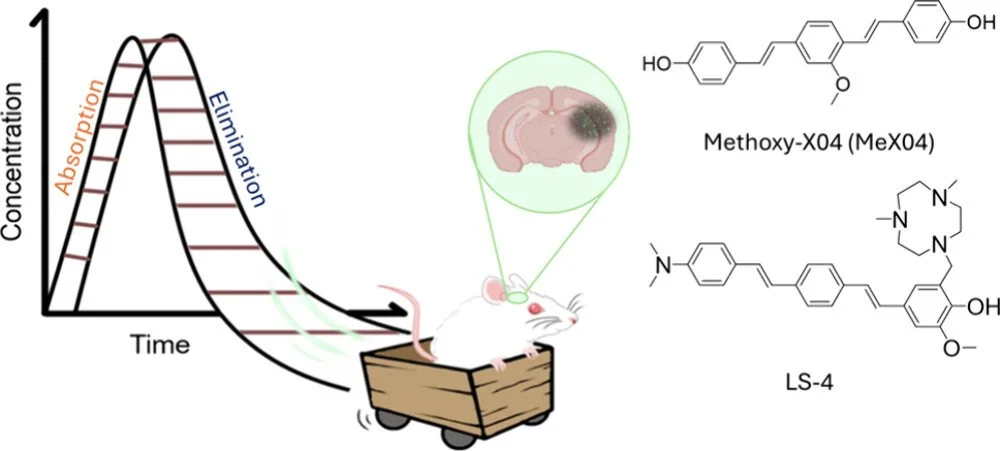
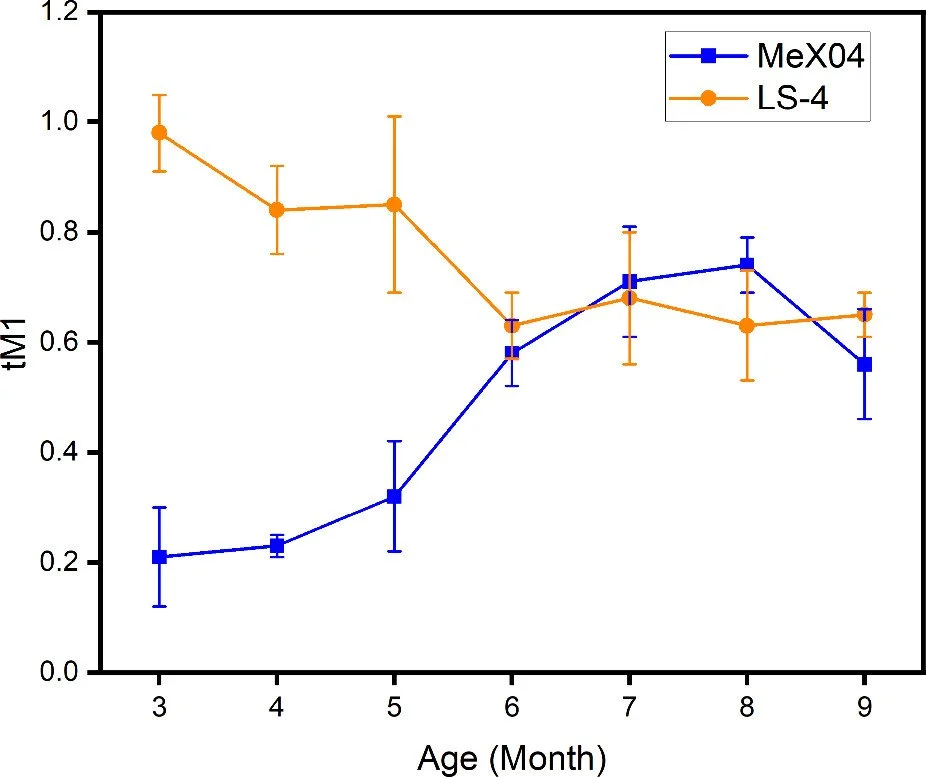
The pharmacokinetics (PK) and biodistribution of radiolabeled amyloid-β (Aβ)-targeting probes have been extensively characterized in the context ofAlzheimer’s disease (AD), whereas the corresponding nonradiolabeled scaffolds remain largely unexplored in vivo. Herein, we report in vivo PK studies of the widely used amyloid probemethoxy-X04 (MeX04) in transgenic5xFAD and wild-type (WT)mice. In plasma, MeX04 shows comparable exposure between 5xFAD and WT mice, indicating no major genotype-dependent differences in systemic clearance. In contrast, brain exposure was markedly increased in 5xFAD mice, with higher brain Cmax and AUC parameters and slower washout, consistent with Aβ-dependent sequestration and retention in the AD brain tissue. Notably, fluorescence microscopy revealed that the fluorescence intensity of amyloid plaque-bound MeX04 closely mirrored the total brain concentration, and we employed ex vivo fluorescence intensity quantification to evaluate the PK of a related bis (styryl)benzenecompound, LS-4, which is proposed to exhibit increased affinity for soluble Aβaggregates.Wethenperformedage-dependentexvivostainingofcompoundboundAβaggregatesin5xFADbrains,andLS-4exhibitsappreciableamyloid-boundfluorescenceintensityinyounger5xFADmice, consistent with its higher affinity for Aβoligomers, whereas MeX04 exhibited stronger fluorescence intensity in older mice. Consequently, we propose an efficient approach to track temporal changes in the PK of Aβ-binding compounds by ex vivo evaluation of their amyloid-bound fluorescence intensity, providing a rapid assessment of the general PK trends of newly developed amyloid-binding probes.
Xu, K.; Salaiza, J. A.; Adeoye, H.; Bhowmik, S.; Sayed, T. E.; Rana, M.; Mirica, L. M. Pharmacokinetic Studies of Amyloid-Targeting Bis(styryl)benzene Agents for Alzheimer’s Disease. ACS Chemical Neuroscience 2026, 17 (13), 2533–2542. https://doi.org/10.1021/acschemneuro.6c00361.
Design of bifunctional pyridinophane ligands as Mn2+ MRI agents for diagnostic imaging of Alzheimer's disease
Tarek El Sayed, Akhil Patel, Kerui Xu, Jennifer A. Salaiza, Husna Azhakath Valappil, Shreyan Majumdar, Bradley P. Sutton, and Liviu M. Mirica*
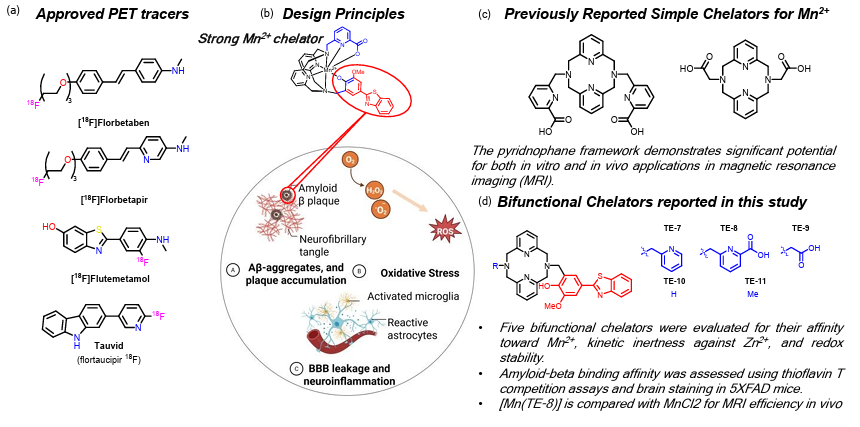
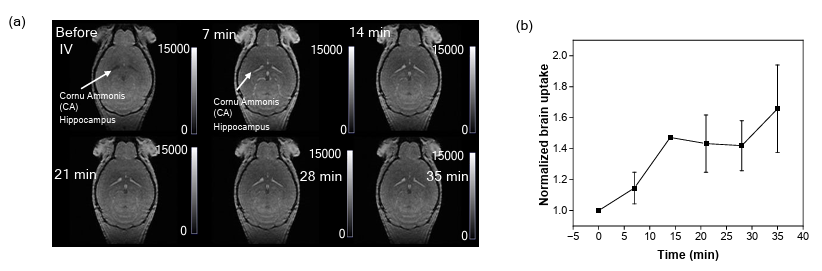
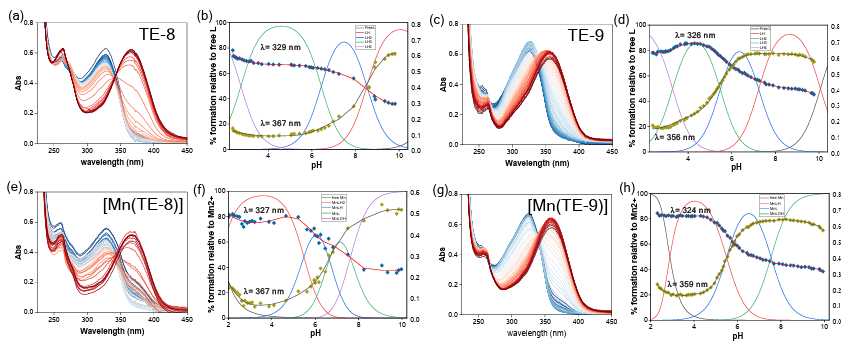
Alzheimer's disease (AD) is a progressive neurodegenerative disorder whose prevalence is rising with the aging of the global population. Among the proposed pathological hallmarks, the amyloid-beta (Aβ) peptide aggregates and soluble Aβ oligomers are established biomarkers and remain valuable diagnostic targets. While positron emission tomography (PET) imaging agents dominate AD diagnostic imaging, there are no FDA-approved MRI agents for AD. Herein, we report five bifunctional chelators built on the 2,11-diaza[3.3](2,6)pyridinophane framework, which were evaluated as chelators for Mn 2+ -based MRI contrast agents. Based on in vitro studies, including thermodynamic stability and kinetic inertness measurements, and T1 relaxivity and 17O transverse relaxivity measurements to extract hydration numbers and water-exchange parameters, we obtained a clear structure-activity correlation for the corresponding bifunctional chelators: anionic picolinate and acetate arms increase thermodynamic stability and kinetic inertness, while the benzothiazolyl-phenol arm accelerates water exchange. Importantly, a high hydration number alone is insufficient, as rapid water exchange is also needed for an appreciable contrast. Moreover, we show that both the bifunctional chelators and their Mn2+ complexes exhibit appreciable affinity for Aβ aggregates, both in vitro and in 5xFAD mouse brain sections. [Mn(TE-8)], the most kinetically inert complex with favorable relaxivity, log D, and Aβ affinity, was advanced to in vivo MRI studies. Unlike MnCl2, which accumulates non-specifically, [Mn(TE-8)] cleared through renal and hepatobiliary routes and produced measurable brain contrast enhancement. Together, these results establish the diazapyridinophane scaffold as a viable first-generation platform for blood-brain-barrier-permeable Mn2+ MRI contrast agents.
Sayed, T. E.; Patel, A.; Xu, K.; Salaiza, J. A.; Valappil, H. A.; Majumdar, S.; Sutton, B.; Mirica, L. M. Design of bifunctional pyridinophane ligands as Mn 2+ MRI agents for diagnostic imaging of Alzheimer’s disease. Inorganic Chemistry Frontiers 2026. https://doi.org/10.1039/d6qi01745b.
Bis(styryl)benzene Probes for Targeting Early-Stage Amyloid-β Aggregates in Alzheimer’s Disease
Citlali Gutíerrez, Marie Mina, Jusung An, Saumitra Bhowmik, Kerui Xu, Jennifer Salaiza, Katie Chen, Tarek El Sayed, and Liviu M. Mirica*
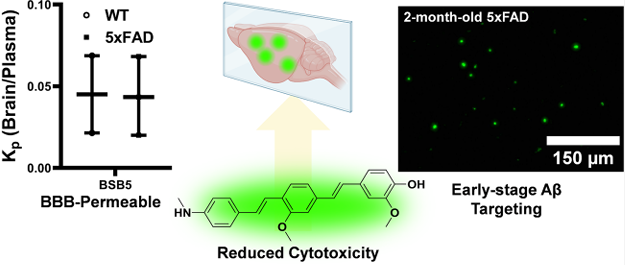
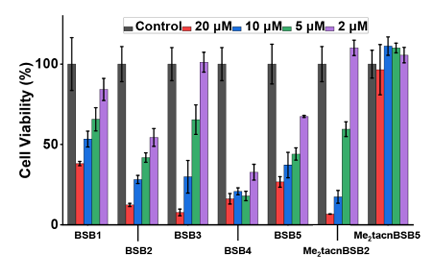
With the recent FDA approval of antibody-based therapeutics for Alzheimer’s disease (AD), the need for diagnostic tools capable of detecting the disease at the earliest stages has become increasingly urgent. Although small molecules offer advantages in terms of production, stability, and accessibility, no imaging agent currently enables reliable detection of early-stage aggregates of the amyloid-β (Aβ) peptide, among the earliest biomarkers in AD progression. Herein, we report a series of bis(styryl)benzene(BSB)probesderivedfromthemethoxy-X04scaffoldandasystematicstructure−activityinvestigationexamining howtargetedmolecularmodifications, includinghydroxylpositioning,(Me)HNor(Me)2Nsubstitution,andincorporationofa1,4dimethyl-1,4,7-triazacyclononane(tacn)moiety,modulateAβbinding, cytotoxicity,andbrainuptake.Thesemethoxy-X04analogues retainAβaffinitywhileexhibitingmarkedly improvedcytotoxicityprofiles and logDvalues consistentwith invivoapplicability. Amyloid-βbindingwas evaluatedusing age-dependent in situ stainingof 5xFADmousebrain sections, supportedby invitro fluorescence-basedoligomer andfibril assays and in silico analyses that reveal tunable selectivity toward early versus lateAβ aggregates. In vivo brain uptake studies of BSB5 and Me2tacnBSB5 further support theutilityof theseprobes asmodularAβtargetingfragments for thedevelopmentofearly-stageADimagingagents.
Gutíerrez, C.; Mina, M.; An, J.; Bhowmik, S.; Xu, K.; Salaiza, J.; Chen, K.; Sayed, T. E.; Mirica, L. M. Bis(styryl)benzene Probes for Targeting Early-StageAmyloid-β Aggregates in Alzheimer’s Disease. ACS Chemical Neuroscience 2026. https://doi.org/10.1021/acschemneuro.6c00429.
Pyridinophane Ligands: An Attractive Chelator Platform for Mn-Based Imaging Agents
Tarek El Sayed, Karna Terpstra, Jennifer Whetter, Kerui Xu, Lingyang Zhu, Sagnik Chakrabarti, Axia Marlin, Andrew Wessel, Shreyan Majumdar, Bradley P. Sutton, Eszter Boros, Liviu M. Mirica*
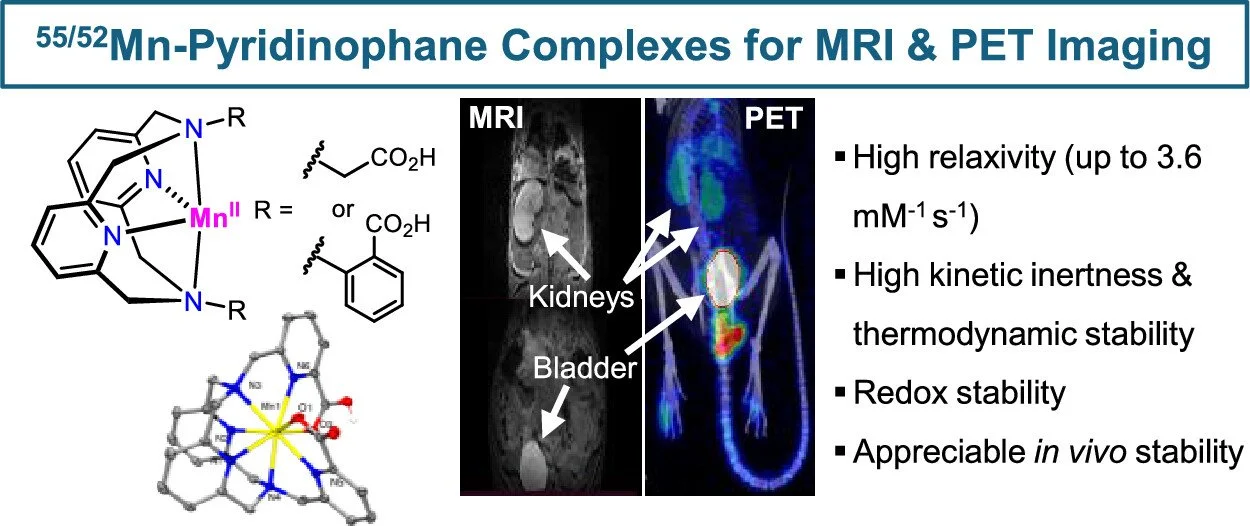
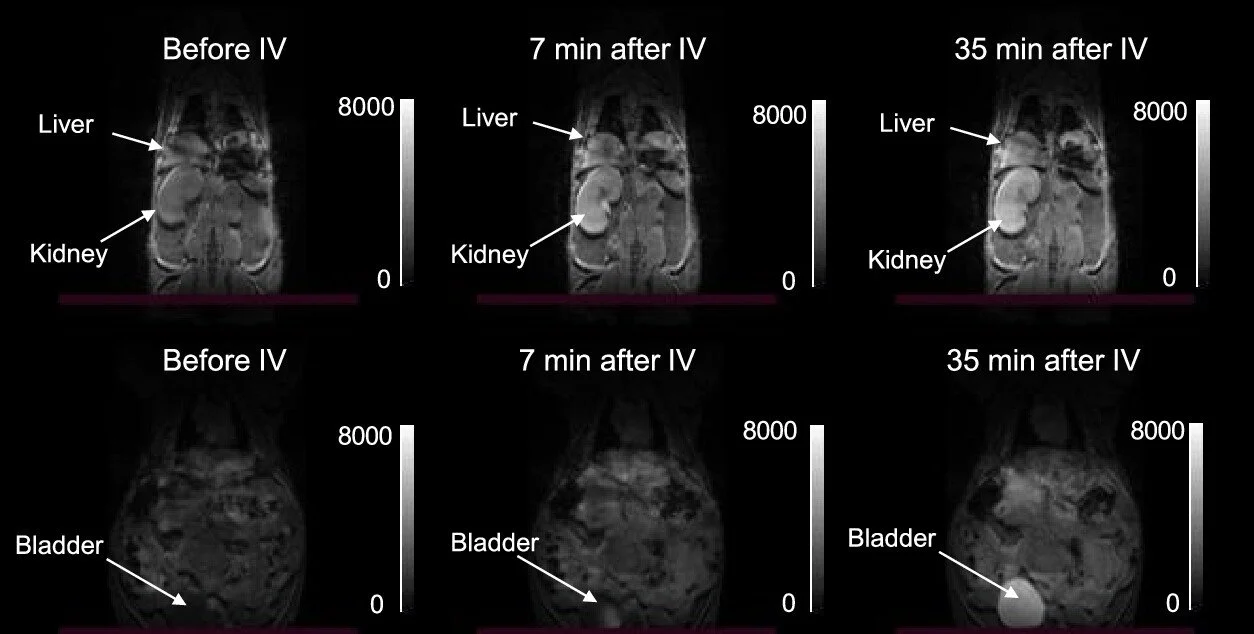
Manganese-based magnetic resonance imaging (MRI) contrast agents were developed using chelators derived from the 2,11-diaza[3.3](2,6)pyridinophane macrocycle to enhance Mn2+ relaxivity. The synthesized chelators were assessed to determine how coordination number and pendant arm selection affect the efficiency of the resulting Mn-based MRI contrast agents. Two compounds demonstrated significant potential: [Mn(TE-1)] exhibited relaxivity comparable to clinical gadolinium-based agents (3.6 mM–1 s–1 at 1.4 T), while [Mn(TE-4)] displayed rapid renal clearance and strong contrast enhancement in the kidney and bladder. In vivo PET imaging with 52Mn confirmed that [Mn(TE-4)] undergoes renal excretion, supporting its further development as an MRI or PET imaging agent. The lipophilic [Mn(TE-1)] exhibited both biliary and renal excretion, indicating its suitability as a blood pool MRI agent and for potential immuno-PET applications.
Sayed, T. E.; Terpstra, K.; Whetter, J.; Xu, K.; Zhu, L.; Chakrabarti, S.; Marlin, A.; Wessel, A.; Majumdar, S.; Sutton, B. P.; Boros, E.; Mirica, L. M. Pyridinophane Ligands: an attractive chelator platform for MN-Based imaging agents. Journal of Medicinal Chemistry2026, 69 (9), 10448–10462. https://doi.org/10.1021/acs.jmedchem.5c03597.


Evaluation of Anti-Alzheimer's Potential of Azo-Stilbene-Thioflavin-T derived Multifunctional Molecules: Synthesis, Metal and Aβ Species Binding and Cholinesterase Activity
Monika Rana, Karna Terpstra, Citlali Gutierrez, Kerui Xu, Hemant Arya, Tarun K. Bhatt, Liviu M. Mirica*, and Anuj K. Sharma*
Inhibition of amyloid β (Aβ) aggregation and cholinesterase activity are two major therapeutic targets for Alzheimer's disease (AD). Multifunctional Molecules (MFMs) specifically designed to address other contributing factors, such as metal ion-induced abnormalities, oxidative stress, toxic Aβ aggregates etc., are very much required. Several multifunctional molecules have been developed using different molecular scaffolds. Reported herein is a new series of four MFMs based on ThT, Azo-stilbene, and metal ion chelating pockets. The synthesis, characterization, and metal chelation ability for [Cu2+ and Zn2+] are presented herein. Furthermore, we explored their multifunctionality w.r.t. to their (i) recognition of Aβ aggregates and monomeric form, (ii) utility in modulating the aggregation pathways of both metal-free and metal-bound amyloid-β, (iii) ex vivo staining of amyloid plaques in 5xFAD mice brain sections, (iv) ability to scavenge free radicals, and (v) ability to inhibit cholinesterase activity. Molecular docking studies were also performed with Aβ peptides and acetylcholinesterase enzyme to understand the observed inhibitory effect on activity. Overall, the studies presented here establish the multifunctional nature of these molecules and qualify them as promising candidates for furthermore investigation in the quest for finding Alzheimer's disease treatment.
Rana, M.; Terpstra, K.; Gutierrez, C.; Xu, K.; Arya, H.; Bhatt, T. K.; Mirica, L. M.; Sharma, A. K. Evaluation of Anti‐Alzheimer’s Potential of Azo‐Stilbene‐Thioflavin‐T derived Multifunctional Molecules: Synthesis, Metal and Aβ Species Binding and Cholinesterase Activity. Chemistry - a European Journal 2024, 31 (2), e202402748. https://doi.org/10.1002/chem.202402748.